
Risk Disclaimer: This article is for research purposes only in the areas of Crypto, RWA, Tokenized Stocks, and the semiconductor industry. It does not constitute investment advice. AMATB is a tokenized stock asset related to Applied Materials. Specific rights, custody mechanisms, redemption rules, trading restrictions, applicable regulations, and risk structures shall be governed by platform documentation, offering materials, and official disclosures. Holding AMATB should generally not be understood as directly holding Applied Materials stock.
If this is your first time searching “what is AMATB” or “what is AMATB coin,” the most common misconception is: Is AMATB a new cryptocurrency officially issued by Applied Materials?
The answer is: No.
AMATB is best understood as a tokenized stock asset whose price is linked to Applied Materials stock — a digital representation of a traditional equity asset entering the crypto market. It falls under RWA (Real World Assets), i.e., the tokenization of real-world assets.
Simply put, AMATB is not a native crypto asset like BTC or ETH, nor is it a blockchain token issued by Applied Materials itself. Its core logic is: through token form, it provides crypto users with price exposure to Applied Materials stock.
But that does not mean buying AMATB equals buying Applied Materials stock. The SEC’s Investor.gov explains that tokenized securities can be financial instruments such as stocks, bonds, or fund shares recorded on a blockchain or distributed ledger; among them, synthetic tokenized securities may only provide price exposure to the reference security, and investors do not own rights against the issuer of the reference security.
Therefore, researching AMATB is not about treating it as a “new coin,” but about understanding the underlying Applied Materials stock logic, semiconductor equipment cycles, AI infrastructure demand, RWA mechanisms, liquidity risks, and regulatory differences.
1. What Is AMATB? Why Tokenize Applied Materials Stock?
AMATB’s core positioning is a tokenized expression of Applied Materials-related equity assets.
It is not an independent public blockchain, not a Meme Coin, not a typical DeFi governance token — it is closer to a “digital on-ramp for traditional U.S. equity assets within the crypto market.”
Users can view AMATB/USDT real-time quotes, price trends, and market data on HIBT to observe current price, candlestick changes, trading volume, and market performance.
1.1 What Is the Basic Definition of AMATB?
AMATB is a tokenized stock — i.e., a tokenized equity asset.
More specifically, it belongs to the RWA asset class. The core of RWA is to represent real-world assets — such as stocks, bonds, funds, gold, real estate, private assets, or other financial products — through blockchain or digital asset formats, allowing crypto users to gain exposure to those underlying assets.
AMATB is not a crypto coin officially issued by Applied Materials.
AMATB is not a new public-chain token.
AMATB is not a native crypto asset that derives value from its own blockchain network, like BTC or ETH.
It is more akin to a digital asset that provides price exposure to a traditional stock via blockchain representation.
In the tokenized stock market, similar products are typically used to give users economic exposure to traditional equities. For example, with Kraken xStocks, the FAQ states that xStocks are tokenized representations of U.S. stocks and ETFs, with some products backed 1:1 by underlying equity, but the same disclosure emphasizes that holding xStocks does not equate to buying the underlying company’s stock and generally does not confer cash dividends, voting rights, or traditional shareholder rights.
So, for AMATB, the first step is to distinguish clearly: it is not Applied Materials stock itself, but rather a tokenized stock asset related to Applied Materials.
1.2 What Is the Relationship Between AMATB and Applied Materials Stock (AMAT)?
Traditional Applied Materials stock typically refers to Applied Materials, Inc. traded on NASDAQ as AMAT. Investors who buy AMAT through a traditional brokerage account hold listed company shares within the securities account system, with rights governed by brokers, custody systems, stock market rules, and corporate governance structures.
AMATB, on the other hand, is a tokenized trading form in the crypto market.
It is typically priced and traded against digital assets like USDT. Users trade AMATB/USDT on crypto platforms, rather than directly buying AMAT stock through a traditional brokerage account.
The price logic of the two may be correlated.
If Applied Materials’ business performance grows, semiconductor equipment orders are strong, AI data center investment expands, and advanced-node capex increases, AMAT stock may be re-priced by the market. As a tokenized asset tied to Applied Materials, AMATB’s price may also be influenced by AMAT stock performance, market expectations, and trading demand.
But the two cannot be directly equated.
Holding AMAT stock may involve traditional shareholder rights, corporate voting, securities account custody, and securities regulation.
Holding AMATB depends on the token issuer, custody structure, redemption mechanisms, platform rules, and specific product terms. Some tokenized stocks may only provide price exposure without granting traditional stockholder rights.
This is the core distinction that AMATB investors must understand.
1.3 Why Are More U.S. Equities Entering Crypto?
Traditional stock trading typically relies on investors, brokers, stock exchanges, clearing houses, banking systems, and local regulatory frameworks.
This model is mature, but it has certain limitations.
- High account opening barriers.
- Inconvenient access to U.S. stocks for users in some regions.
- Trading hours restricted by stock exchanges.
- Funds must go through banks, currency conversion, wire transfers, or brokerage accounts.
- Stocks are difficult to integrate directly with crypto wallets, stablecoins, and DeFi ecosystems.
Tokenized stocks attempt to address a different set of needs: allowing equity-like assets to enter the crypto market in token form, enabling users to gain exposure to traditional financial assets using USDT, stablecoins, or other digital assets.
Potential advantages include global accessibility, on-chain settlement, lower participation barriers, fractional trading, and potential integration with DeFi. Kraken’s xStocks FAQ also notes that some tokenized stocks support extended trading hours, near-instant settlement, on-chain transfers, and DeFi usage, but clearly warns that such products are not equivalent to traditional stocks.
From a broader trend, assets like AMATB represent the ongoing integration of traditional financial assets into the crypto space. Ethereum, as one of the most important smart contract ecosystems, is also a key infrastructure for RWA development. Users can observe the market relationship between Ethereum and the RWA narrative via ETH price prediction.
2. What Is Applied Materials? Why Does AMATB Matter?
If AMATB is tied to Applied Materials, then researching AMATB cannot stop at crypto charts — you must also understand Applied Materials’ intrinsic business value.
AMATB is not a standalone narrative asset; its underlying reference is the company itself.
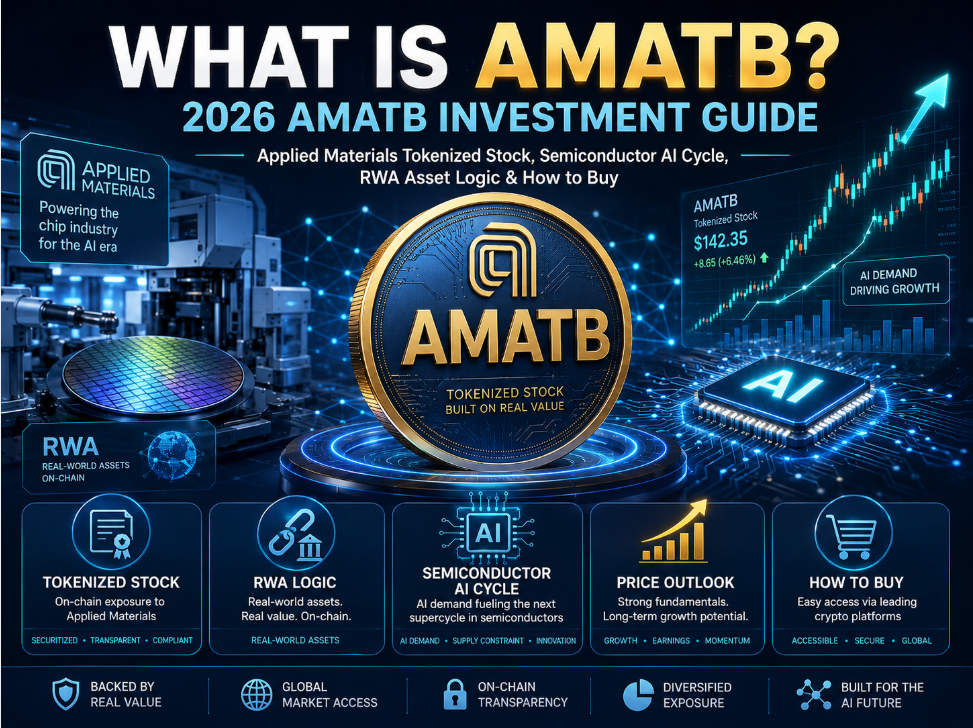
2.1 What Are Applied Materials’ Main Businesses?
Applied Materials, commonly known as “Applied,” is a global leader in semiconductor and display manufacturing equipment. According to official company materials, Applied Materials positions itself as a leader in semiconductor and display equipment manufacturing.
Its core business can be broken into three major areas.
First, semiconductor manufacturing equipment.
Applied Materials provides critical fabrication equipment to chipmakers, foundries, advanced-node producers, and memory chip manufacturers. Semiconductor manufacturing is not just about chip design; it requires a complex ecosystem of deposition, etching, ion implantation, inspection, materials engineering, advanced packaging, and more.
Second, Applied Global Services.
This is the service business around equipment installation, maintenance, upgrades, optimization, and customer support. Once equipment is installed in a fab, follow-up services, maintenance, and process optimization create long-term recurring revenue.
Third, display equipment.
Applied Materials also serves OLED, flat-panel display, and related manufacturing processes. Though less discussed than AI chips, display manufacturing remains an important part of the electronics supply chain.
In its fiscal Q2 2026 earnings, Applied Materials reported record revenue of $7.91 billion, up 11% year-over-year; GAAP gross margin of 49.9%; GAAP EPS of $3.51; with Semiconductor Systems revenue at $5.965 billion and Applied Global Services at $1.665 billion.
These figures show that Applied Materials is not a vague “tech concept” — it is a critical equipment supplier tied to semiconductor capex cycles.
2.2 Why Are Semiconductor Equipment Companies Important in the AI Era?
In the AI era, the most visible names to retail investors are NVIDIA, AMD, cloud providers, and AI applications. But the deeper supply chain logic is: AI model training and inference require massive quantities of GPUs, HBM, high-performance logic chips, advanced packaging, and data center infrastructure.
This drives foundries, memory fabs, and OSATs to continuously invest in advanced nodes, DRAM, HBM, advanced packaging, and related manufacturing capabilities.
And fab expansion and technology upgrades depend on semiconductor equipment.
The chain works like this:
- AI demand grows.
- Data centers and model training need more high-performance chips.
- Chip companies and cloud providers drive demand for advanced chips.
- Foundries and memory makers increase capex.
- Semiconductor equipment companies receive orders and service revenue.
Applied Materials sits precisely at the “equipment and materials engineering” link in this chain.
In its Q2 2026 earnings release, Applied Materials stated that it now expects its semiconductor equipment business to grow over 30% in calendar 2026. Management also emphasized that the rapid global buildout of AI compute infrastructure, combined with the company’s leadership in leading-edge logic, DRAM, and advanced packaging, provides a foundation for multi-year revenue and profit growth.
Therefore, investing in AMATB is not simply betting on a single tech company — it is studying the convergence of AI infrastructure, semiconductor capex cycles, advanced manufacturing, and tokenized RWA assets.
2.3 How Does AMATB Differ From NVIDIA and AMD?
Many newcomers see “AI semiconductor” and think of NVIDIA and AMD. But AMATB’s underlying Applied Materials operates in a different segment.
- NVIDIA and AMD are primarily chip design companies.
- TSMC is primarily a chip manufacturing foundry.
- Applied Materials is primarily a semiconductor equipment and materials engineering company.
Using a simple analogy: in the AI gold rush, NVIDIA and AMD are like those who design and sell high-performance chips; TSMC is like the factory that manufactures them; Applied Materials is like the company that sells the essential tools and process equipment to the factory — the “pick-and-shovel” provider.
Such companies are not as directly exposed to end-product sales as chip designers, but they are deeply tied to semiconductor capex cycles. If AI, advanced nodes, HBM, and advanced packaging continue to expand, equipment demand benefits; if fabs cut capex or the industry enters a downturn, Applied Materials would feel the pressure.
So, the investment thesis for AMATB is not “AI chips go up, so this goes up” — rather, it requires analyzing whether AI demand actually translates into wafer fab capex and Applied Materials orders.
3. How Does AMATB Work? Mechanisms Behind Tokenized Stocks
Many users ask: how can a token represent stock value?
The answer depends on the issuance mechanism, asset custody, pricing rules, and platform structure.
Different tokenized stock products may adopt different models. Some may be 1:1 asset-backed, others may be synthetic exposures, some may be derivative structures, and some may be subject to securities rules in certain jurisdictions.
3.1 How Does AMATB Track Applied Materials?
AMATB’s price is typically influenced by Applied Materials’ stock price, but it may not be perfectly synchronized.
Generally, the price-mapping logic for tokenized stocks works as follows:
- The Applied Materials stock price serves as the underlying reference.
- The issuer or platform uses asset custody, price feeds, market-making mechanisms, on-chain certificates, or derivative structures to reflect the AMAT stock price in the token price.
- Users buy and sell AMATB on crypto markets using USDT or other assets.
- Market supply/demand, liquidity, trading hours, and platform rules affect AMATB’s executed price.
Thus, AMATB’s price can be influenced by four types of factors:
- Applied Materials stock price — the most fundamental reference.
- Token market liquidity — if trading depth is thin, price may deviate from AMAT stock in the short term.
- Issuance mechanism — whether real assets are custodied, whether proof of reserves is public, and whether redemptions are supported affect market trust.
- Trading demand — if crypto users show rising interest in semiconductors, AI, and U.S. equity tokens, AMATB may gain attention and trading activity.
3.2 Is AMATB Backed by Real Assets?
This is the most critical question in RWA investing.
Investors must examine:
- Who is the issuer?
- Is there actual Applied Materials stock or related financial assets held in custody?
- Is the custodian regulated?
- Are proof-of-reserves or audit reports publicly available?
- Is redemption supported? If so, is it cash redemption, stock redemption, or only on-platform selling?
- Are there geographic restrictions?
- Do token holders have shareholder rights?
- Are there voting rights, dividend rights, or traditional securities investor protections?
Investor.gov distinguishes several models of tokenized securities: Issuer-sponsored tokenized securities may be issued directly on-chain by the company or its agent, carrying legal rights similar to traditional shares; Custodial tokenized securities may represent indirect interests held through securities intermediaries; Synthetic tokenized securities may only provide price exposure to the reference security, with no rights against the reference issuer.
Therefore, AMATB investors cannot default to “it must be backed by real stock” nor “it must not be backed.” Everything depends on the specific offering documents, platform disclosures, and product terms.
The essence of RWA investing is not just price — it is the authenticity of asset mapping, issuance transparency, custody safety, and redemption mechanisms.
3.3 What Are the Key Differences Between AMATB and Traditional Stock?
Traditional stock represents an equity interest in a public company, with trading, custody, clearing, shareholder rights, and regulatory oversight operating within the securities market system.
AMATB, on the other hand, is a token-form stock-related asset. Trading occurs in crypto markets, typically priced in USDT, and depends on issuance mechanisms, platform trading rules, and token custody arrangements.
Traditional stock may grant shareholder rights such as voting, dividends, and securities investor protections.
AMATB generally emphasizes price exposure and trading convenience, but whether it carries shareholder rights depends on the specific product structure.
This is the biggest distinction between AMATB and AMAT stock:
- AMAT is the listed company’s stock.
- AMATB is a tokenized stock-related asset.
Prices may be correlated, but rights structures and risk sources differ.
4. How to Buy AMATB? A Step-by-Step Guide for Beginners
If you already understand that AMATB is not Applied Materials’ official cryptocurrency and is not directly equivalent to AMAT stock, then the next question is “how to buy AMATB.”
4.1 What Do You Need to Invest in AMATB?
Before buying AMATB, you typically need four things:
- A crypto account — choose a platform that supports AMATB/USDT trading, complete registration, security settings, and required KYC.
- USDT funds — AMATB is usually priced against USDT, so you need to have USDT ready.
- A platform that supports AMATB trading — not all exchanges offer tokenized stocks. Confirm that the platform lists the AMATB/USDT pair and that your jurisdiction allows trading such assets.
- Basic risk awareness — understand that you are buying a tokenized stock asset related to Applied Materials, not direct shares. Also acknowledge risks like price deviation, illiquidity, platform risk, and regulatory uncertainty.
4.2 Step-by-Step Process to Buy AMATB
Beginners can follow this general flow:
Step 1: Register on a trading platform that supports AMATB. Complete account setup, enable two-factor authentication, fund passwords, anti-phishing codes, etc.
Step 2: Deposit USDT. Confirm the deposit network, address, and chain supported by the platform. Do not send USDT to the wrong network, or you may lose your assets.
Step 3: Search for the AMATB/USDT pair. Go to the trading page, look up the AMATB pair, and verify the pair name, price, and market data.
Step 4: Choose your order type. For quick execution, use a market order (watch for slippage). To control entry price, use a limit order (not guaranteed to fill immediately).
Step 5: After purchase, continue monitoring. Track not only AMATB price but also Applied Materials stock performance, semiconductor capex cycles, AI infrastructure demand, RWA regulatory developments, and token liquidity.
4.3 What Are the Trading Risks of AMATB?
AMATB trading risks fall into four main categories:
- Liquidity risk — token trading volume may be lower than that of traditional AMAT stock. If the order book is shallow, large orders may cause significant slippage.
- Price deviation risk — AMATB price may be influenced by AMAT stock but can also deviate due to crypto market supply/demand, platform liquidity, trading hours, and market-making mechanisms.
- Platform risk — exchange security, custody arrangements, withdrawal rules, technical failures, and compliance changes can all affect user assets.
- Regulatory risk — different jurisdictions have different stances on tokenized stocks. Some may restrict trading, and users must comply with local laws and platform rules.
Thus, AMATB is not a “low-risk substitute for U.S. stocks” — it is a combination of traditional stock risk, tokenization structural risk, and crypto trading risk.
5. AMATB Price Prediction: Where Does Future Upside Come From?
When users search for “AMATB price prediction,” they really want to know: will AMATB rise in the future, and what drives its upside?
But a price prediction cannot be simplified to “target price X.” It requires simultaneous analysis of Applied Materials’ fundamentals, the AI semiconductor cycle, U.S. tech valuations, RWA market development, and the token’s own liquidity.
5.1 What Factors Affect AMATB Price?
- Applied Materials’ performance — revenue growth, profitability, semiconductor orders, gross margin, services revenue, and free cash flow all affect AMAT stock and, indirectly, AMATB.
- AI and semiconductor cycles — rising AI investment drives GPU, HBM, advanced logic, and packaging demand, which in turn fuels fab expansion and equipment purchases. If this cycle persists, Applied Materials stands to benefit.
- U.S. macro environment — as a U.S. tech and semiconductor asset, AMAT is influenced by interest rates, inflation, dollar liquidity, tech valuations, capex cycles, and global economic conditions.
- RWA market development — broader crypto investor acceptance of stock tokens can increase attention and liquidity for assets like AMATB. Conversely, regulatory restrictions or weak demand could limit market depth.
- AMATB’s own trading structure — even if Applied Materials stock rises, AMATB may deviate if liquidity is poor, issuance is opaque, or trading is constrained.
5.2 How to Analyze AMATB’s Future Value?
Instead of asking “how many X can it do,” better questions include:
- Is Applied Materials still a core supplier of semiconductor equipment?
- Does AI infrastructure investment consistently translate into wafer fab capex?
- Are DRAM, HBM, advanced packaging, and leading-edge logic demand strong?
- Is AMAT’s valuation already pricing in the AI cycle?
- Does AMATB have a clear token mechanism?
- Is AMATB trading liquidity sufficient?
- Is the RWA market continuing to expand?
- Does the crypto market support demand for tokenized stock trading?
Users can view AMATB price prediction for trend references and scenario analysis. But price predictions are research tools, not guarantees of returns.
True judgment on AMATB should combine Applied Materials’ fundamentals, semiconductor cycles, token mechanisms, trading liquidity, and the broader crypto environment.
6. Is AMATB Worth Investing In? Full Analysis of Pros and Cons
Whether AMATB is worth investing in depends on your view of Applied Materials’ long-term value, the AI semiconductor cycle, RWA asset structures, and tokenized stock risks.
6.1 Potential Advantages of AMATB
- AI infrastructure exposure — Applied Materials operates in a segment that may benefit long-term from AI compute demand, chip upgrades, advanced nodes, HBM, advanced packaging, and fab investment.
- Access to U.S. tech assets — for crypto users already holding USDT, AMATB offers a potential on-ramp to U.S. tech equities without a traditional brokerage account.
- RWA growth trend — traditional financial assets are increasingly moving onto blockchains. Stocks, bonds, funds, gold, indices, and other real-world assets may continue to be tokenized into the crypto financial system.
- Unique supply-chain position — unlike NVIDIA (selling GPUs) or TSMC (pure-play foundry), Applied Materials provides critical equipment and process solutions — a “picks-and-shovels” role worth studying in the AI ecosystem.
6.2 Risks of AMATB
- Not direct stock — holding AMATB generally does not make you an Applied Materials shareholder, and you may lack voting rights, dividends, or traditional investor protections.
- Dependence on issuer mechanisms — if AMATB relies on third-party issuance, custody, market-making, or redemption, the credibility of those parties is critical.
- Semiconductor industry cyclicality — equipment suppliers are highly dependent on customer capex. If fabs delay expansion, memory cycles weaken, or advanced-node investment slows, Applied Materials may suffer.
- Crypto market volatility — even if AMAT stock is stable, crypto sentiment, stablecoin liquidity, platform liquidity, and trading demand can affect AMATB price.
- Regulatory shifts — tokenized stocks may be treated as securities, derivatives, or other financial products across jurisdictions. Regulatory changes could impact trading eligibility, listing status, KYC requirements, and redemption mechanisms.
Therefore, AMATB is better suited for users willing to research RWA mechanics, understand semiconductor industry cycles, and tolerate crypto market volatility — not for beginners seeking short-term moonshots.
7. How Does AMATB Differ From Other Crypto Assets?
Understanding AMATB requires a clear taxonomy of crypto assets. Different assets cannot be analyzed with the same logic.
7.1 AMATB vs. BTC/ETH
- BTC derives value from digital-gold narratives, scarcity, decentralized consensus, and institutional allocation.
- ETH derives value from smart contract ecosystems, DeFi, Layer 2, RWA, stablecoins, and developer networks.
- AMATB derives value from Applied Materials’ enterprise value, semiconductor equipment cycles, AMAT stock performance, tokenized stock mechanisms, and crypto trading demand.
So AMATB is not BTC or ETH. It belongs to the tokenization of traditional equity assets.
7.2 AMATB vs. SPCX
SPCX is another example of financial asset tokenization. You can read what SPCX is to understand another type of tokenized asset entering the crypto market.
The differences between AMATB and SPCX:
- AMATB corresponds to a publicly listed company (Applied Materials) stock-related asset.
- SPCX leans toward specialized financial assets or non-traditional listed equity exposures.
- AMATB’s price logic is more easily referenced against public stock markets.
- SPCX may involve different valuation, liquidity, and information transparency issues.
Both fall under RWA or tokenized asset frameworks, but underlying assets, investment logic, and risk sources differ.
7.3 AMATB vs. XVG, THETA, PIPEDOG
Crypto includes many asset types:
- XVG is a privacy-payment asset focused on private payments, low-cost transfers, and digital currency payment scenarios.
- THETA is a Web3 video, AI compute, and DePIN infrastructure project focused on edge nodes, AI compute resources, and decentralized content delivery.
- PIPEDOG leans more toward a meme-community asset driven by community virality, meme culture, sentiment, and liquidity.
AMATB, by contrast, is an RWA asset focused on Applied Materials’ enterprise value, semiconductor equipment cycles, stock price exposure, token issuance mechanisms, and trading risks.
These assets have completely different value drivers:
- XVG → privacy payments.
- THETA → infrastructure.
- PIPEDOG → community hype.
- AMATB → semiconductor equipment value and RWA mechanisms.
The biggest mistake beginners make is treating all crypto assets as just “coins.” A mature research approach first identifies the asset class, then applies the appropriate analytical framework.
8. AMATB Investment FAQ
Q1: What is AMATB?
AMATB is a tokenized stock asset tied to Applied Materials. It can also be viewed as an RWA asset that provides price exposure to a traditional stock through blockchain or crypto market formats. It is not a native crypto asset like BTC or ETH, but a tokenized representation of a traditional equity.
Q2: Is AMATB issued by Applied Materials?
No. AMATB should generally not be understood as a digital currency officially issued by Applied Materials, nor as a blockchain project token from the company. It is more likely a tokenized stock product provided by third-party financial infrastructure or trading platforms. The specific issuer and product structure depend on platform disclosures.
Q3: Does buying AMATB equal buying AMAT stock?
No. While AMATB’s price may correlate with Applied Materials stock price movements, holding AMATB typically does not mean direct ownership of Applied Materials shares, nor does it necessarily confer voting rights, dividends, or traditional brokerage account entitlements. The specific rights depend on the issuance model and platform rules.
Q4: Is AMATB suitable for long-term investment?
Whether AMATB is suitable for long-term holding depends on Applied Materials’ fundamentals, semiconductor cycles, RWA mechanisms, token liquidity, issuer credibility, regulatory environment, and your personal risk tolerance. If you are bullish on the AI semiconductor equipment cycle but do not understand tokenized stock structures, you should first study the product rules rather than treating AMATB as a direct substitute for AMAT stock.
Q5: Will AMATB rise in the future?
AMATB’s price depends on Applied Materials’ performance, AI semiconductor trends, U.S. tech market conditions, RWA market development, and crypto liquidity. No price prediction is a guarantee of returns. You may refer to AMATB price prediction, but always combine it with your own independent risk assessment.
Q6: Who is AMATB suitable for?
AMATB is more suitable for investors who already understand crypto trading, USDT transactions, RWA assets, tokenized stock mechanisms, and are willing to research the semiconductor equipment industry and Applied Materials’ fundamentals. It is not suitable for those who have no understanding of stocks, token issuance structures, cannot tolerate volatility, or are simply chasing short-term pumps.
Q7: What is the biggest risk of investing in AMATB?
The biggest risks include: AMATB not being Applied Materials stock itself; issuer credit risk; custody risk; price deviation risk; platform risk; liquidity risk; semiconductor industry cyclical risk; and regulatory changes. Before investing, you must confirm AMATB’s specific product structure, trading rules, and applicable requirements in your jurisdiction.
9. Conclusion: AMATB Represents a New Convergence of the AI Industry and Crypto Finance
AMATB is not a traditional cryptocurrency.
It represents a new form of traditional equity assets entering the crypto market:
- Stock-related assets of Applied Materials.
- Digitized through a tokenized stock structure.
- Traded with digital assets like USDT.
- Providing crypto users with price exposure to a semiconductor equipment leader.
The emergence of such assets shows that the crypto market is expanding beyond pure public-chain tokens, meme coins, and DeFi assets — into stocks, ETFs, bonds, gold, semiconductor supply chains, and other real-world assets.
But investors must stay clear-headed.
- AMATB is not Applied Materials official stock.
- AMATB does not necessarily grant traditional shareholder rights.
- AMATB price is affected not only by AMAT stock but also by crypto liquidity, platform mechanisms, and regulatory changes.
Therefore, the focus of researching AMATB is not to find the “next moon coin,” but to answer three questions:
- What exactly is this asset?
- Where does its value come from?
- Where are its risks?
If you can understand AMATB’s RWA nature, Applied Materials’ fundamentals, the semiconductor AI cycle, tokenized stock mechanisms, and trading risks, then AMATB serves as an important case study in the broader trend of traditional financial asset tokenization.
In the future, stock tokens, index tokens, bond tokens, gold tokens, and other RWA assets will likely continue to expand the boundaries of crypto markets. AMATB’s significance lies in connecting a semiconductor equipment giant like Applied Materials with USDT trading, crypto capital, and on-chain financial markets.
For newcomers, understanding the asset logic behind AMATB is far more important than simply guessing its price.