
Written by Hibt Crypto Security Research Team
Recently, the Coldcard hardware wallet security incident has drawn significant attention in the Bitcoin community. Many BTC holders are searching for terms like “Coldcard hack,” “Coldcard vulnerability,” “Bitcoin hardware wallet hack,” and “Is my Bitcoin safe after the Coldcard hack?”
The key takeaway: this is not a breach of the Bitcoin network, nor a failure of Bitcoin’s cryptographic algorithms. Rather, it stems from insufficient randomness in the seed‑generation process on certain Coldcard devices. In other words, the risk lives at the “wallet generates the key” layer—not in the Bitcoin protocol itself.
For everyday Bitcoin holders, the immediate priorities are: Is my Coldcard affected? Do I need to move my BTC? And how do I build a more secure self‑custody setup going forward?
1. What Is the Coldcard Hack? What Happened in This Hardware Wallet Security Event?
This section answers: What actually happened with Coldcard?
Coldcard is a Bitcoin‑only hardware wallet created by Coinkite. Its core purpose is to keep private keys offline in a dedicated device, signing transactions independently—so that your online computer, phone, or malware never directly touches those keys.
In a typical hot wallet, the risk path is: internet‑connected device → wallet manages private keys → malware or phishing sites may access sensitive info.
A hardware wallet’s security model flips that: private keys stay offline; your online computer only builds unsigned transactions; the hardware wallet displays the transaction details and signs them. Coldcard’s own documentation explains that it can generate 12‑ or 24‑word BIP‑39 seeds, and supports signing transactions, firmware updates, and public‑key exports via MicroSD card—reducing direct network exposure.
The core of this incident is not a remote hack of the Bitcoin network, nor a brute‑force attack on BTC addresses. It’s that some firmware versions generated seeds with less randomness than intended. On July 30, 2026, Coinkite published a security advisory, and on August 1 it clarified: if a user generated a seed on affected firmware without adding at least 50 independent, private, and fair dice rolls, and without a strong, unique BIP‑39 passphrase, then the funds could be at risk.
That’s why many users are confused: My device has always been offline, and I never shared my seed phrase—so why could I still be at risk?
Because hardware‑wallet security depends not only on “has the private key been exposed,” but also on “was the private key truly random in the first place.”
2. What Actually Happened in This Coldcard Attack?
According to Coinkite’s advisory, the issue relates to entropy during seed generation. The advisory clearly states that updating firmware fixes the problem for new seeds, but does not repair old seeds already generated on affected firmware. In other words, if your seed was created on a vulnerable version, merely upgrading the firmware does not make that original seed secure again.
Public reports suggest that attackers exploited the weakened randomness to shrink the search space for certain wallets’ private keys, potentially allowing them to derive control over those wallets. Some media mention that hundreds of wallets and hundreds of BTC have been moved, though exact loss figures are still being updated—always refer to official security notices and on‑chain investigations for the final word.
Three points are critical:
- Bitcoin’s protocol is not broken.
- BTC addresses and private‑key cryptography remain intact.
- The flaw lies in the seed‑generation process of specific Coldcard firmware.
This is what makes hardware‑wallet incidents so insidious: if key generation fails, no amount of careful mnemonic storage will save you—your keys may already be compromised.
3. Why Can an “Offline Wallet” Still Be Attacked?
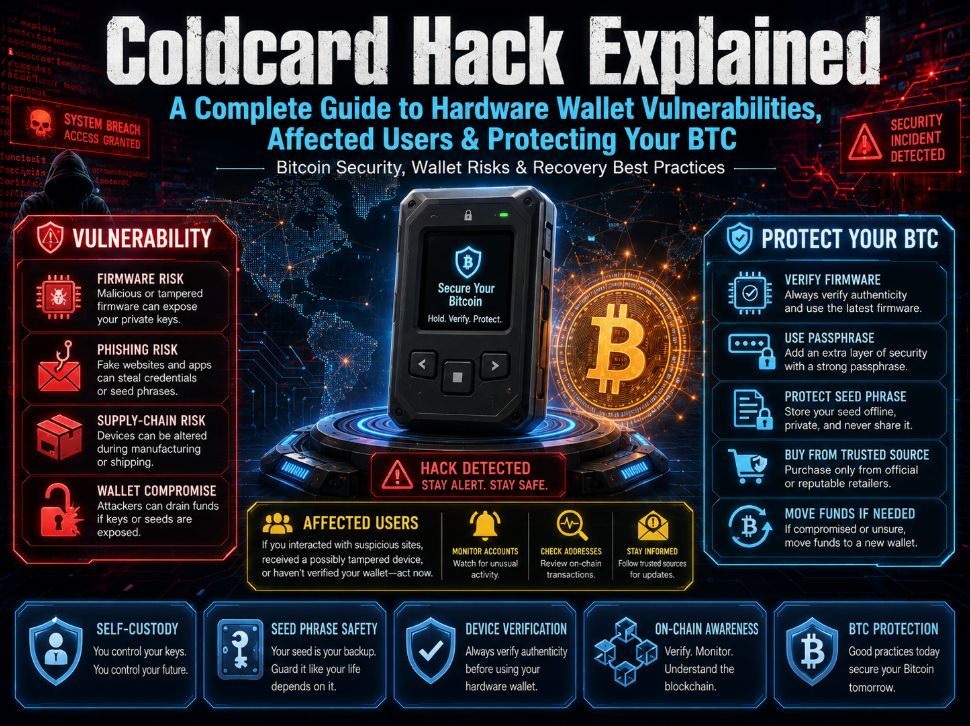
Many crypto newcomers mistakenly believe that a cold wallet equals absolute security.
In reality, a cold wallet reduces the network attack surface, but it does not eliminate all weaknesses. Bitcoin self‑custody security rests on at least three pillars:
Pillar 1 – Private key generation
Your seed must come from sufficiently random, unpredictable entropy. If the random‑number generator is flawed, an attacker may not need to steal your device or see your mnemonic—they can simply try to derive possible seeds by narrowing the search space.
Pillar 2 – Private key storage
If your mnemonic is photographed, uploaded to the cloud, sent over chat, entered into a fake website, or seen by someone else, your BTC can be stolen even if the hardware wallet itself has no flaw.
Pillar 3 – Transaction signing
If you connect to malicious wallet software, fail to verify the recipient address, or blindly sign a transaction, an attacker can trick you into sending funds via address replacement or deceptive transaction content.
Coldcard’s own security documentation emphasises that your security model should be tailored to your portfolio size, threat landscape, current storage methods, and the mistakes you’re most likely to make. Hardware wallets reduce remote‑attack risks, but seed backups, firmware updates, multisig, and user habits are equally important.
So the real educational takeaway from this Coldcard event is: a cold wallet is not a product; it’s a system.
4. Attack Vector Explained: How Could Hackers Find Private Keys That “Should Be Impossible to Guess”?
This section answers: Without access to the device or the seed phrase, how could hackers steal BTC?
Bitcoin wallet security is built on private keys. Your wallet usually derives from a seed phrase, which then generates private keys, public keys, and addresses. As long as the private key is sufficiently random and undisclosed, brute‑force attacks are practically impossible.
Under normal conditions, the Bitcoin private‑key space is astronomically large—even with global computing power, an attacker cannot exhaust it. But if the seed generation lacks randomness, the situation changes drastically.
The wallet‑creation process can be visualised as:
Randomness → Seed → Private Keys → BTC Addresses
If the randomness is strong, the attacker faces an effectively unsearchable space.
If the randomness is weak, that search space shrinks dramatically.
This is why the random‑number generator (RNG or TRNG) is so vital in hardware wallets. Coldcard’s official Master Seed documentation states that the Master Seed is the wallet’s core secret, used to derive all Bitcoin addresses and other secrets; anyone who obtains an unencrypted Master Seed can steal funds, and a weakly generated Master Seed could also be re‑generated by a remote attacker.
In other words, not leaking your mnemonic does not guarantee safety. If the mnemonic originated from a weak random source, an attacker may not need to “steal” it—they can “guess” it through computation.
Think of a safe that is physically robust, but its combination is chosen from a very short list—the safe wasn’t cracked open, but the combination could be deduced.
5. Who Is Affected? Which Coldcard Users Are at Risk?
This section answers: Am I one of them?
According to Coinkite’s official security advisory, affected models include Mk2, Mk3, Mk4, Mk5, and Q, across specific firmware versions. Specifically:
- Mk2 / Mk3: Seeds generated on versions 4.0.1 through 4.1.9 are at risk.
- Mk4 / Mk5: Seeds generated before Standard 5.6.0 or before Edge 6.6.0X are affected.
- Q: Seeds generated before Standard 1.5.0Q or before Edge 6.6.0QX are affected.
Coinkite notes that the impact on Mk4, Mk5, and Q is less severe than on Mk2/Mk3, but still constitutes a serious issue.
High‑risk users therefore include:
- Anyone who generated a wallet seed on an affected Coldcard firmware version.
- Users whose BTC has remained unmoved for a long time, and whose seed was created in affected firmware versions from 2021 onward.
- Holders of large BTC balances in single‑signature wallets.
- Users who did not use a strong BIP‑39 passphrase.
- Users who did not add at least 50 independent, private, fair dice rolls during seed creation.
- Users who only upgraded firmware but did not migrate their old seed.
Coinkite’s advisory explicitly reminds that firmware updates do not change or fix an already‑existing old seed. Unless you qualify for the dice‑roll exception, you should follow the migration guidance.
6. How to Check Whether Your Wallet Is Affected
Follow this self‑check process:
1. Identify your Coldcard model
Are you using Mk2, Mk3, Mk4, Mk5, or Coldcard Q? Each model has a different fixed firmware version.
**2. Confirm the firmware version at the time the seed was generated
Remember: risk depends on the firmware version when the seed was created, not the version you have now. If the seed was created on an affected version, later upgrades do not protect that seed.
3. Check whether you used independent dice entropy
Coinkite states that if you entered at least 50 fair, independent, private dice rolls during seed creation, and those rolls were never recorded or exposed, then that seed is not considered at risk solely due to this RNG issue. Fewer than 50 rolls, or if you don’t remember, treat it as affected and migrate.
4. Check whether you use a strong BIP‑39 passphrase
A strong, unique BIP‑39 passphrase adds an extra security barrier, but does not fix a weak seed. Coinkite recommends that even with a strong passphrase, you should migrate to a newly generated secure seed as soon as practical.
5. Review your BTC balance and risk level
If your wallet holds a small amount, you can be more measured. If you hold significant BTC, prioritise migration—but avoid panic‑induced mistakes.
7. What Does the Coldcard Incident Mean for the Crypto Industry?
This section asks: Is this a Coldcard‑specific problem, or a broader crypto‑security issue?
First, Bitcoin itself remains safe.
This incident does not indicate a break in Bitcoin’s protocol. The blockchain, consensus rules, address system, and cryptographic foundations remain intact. The flaw lives at the wallet‑management layer—specifically, seed generation.
This highlights a crucial distinction:
Bitcoin is secure ≠ your wallet is secure.
Blockchain is secure ≠ your private‑key management is secure.
Self‑custody is secure ≠ buying a hardware wallet is the end of the story.
Second, hardware wallets remain one of the most robust personal custody solutions. Their value is in keeping private keys away from internet‑connected devices, reducing the risk from malware, browser extensions, phishing sites, and remote attacks. As Coldcard’s own documentation notes, as your holdings grow, dedicated hardware and offline backups become essential—and for larger portfolios, multisig is worth considering.
But a hardware wallet is not magic. It still depends on supply‑chain integrity, firmware quality, random‑number generation, backup and recovery processes, address verification, and user behaviour. A failure in any one link can put your assets at risk.
8. How to Protect Your BTC – What Everyday Users Should Do Now
This section answers: What should I do right now?
Step 1 – Assess your wallet status.
Don’t rush into blind actions, and don’t trust “migration guides” from strangers in community chats. First confirm your Coldcard model, current firmware version, approximate time when the seed was generated, whether you used dice rolls, whether you use a BIP‑39 passphrase, and your BTC balance.
Step 2 – Read the official security advisory.
Always rely on Coinkite’s official announcement. Confirm which fixed version applies to your model. The advisory lists:
- Mk2/Mk3: 4.2.0 or higher
- Mk4/Mk5 Standard: 5.6.0 or higher
- Q Standard: 1.5.0Q or higher
- (and corresponding Edge versions)
Step 3 – Do NOT generate new seeds on affected firmware.
Coinkite explicitly warns against creating new seeds on affected models until you have installed the fixed firmware.
Step 4 – Migrate your assets; do not merely upgrade firmware.
If your old seed falls within the affected range, upgrading firmware alone does not make it safe. The correct procedure: upgrade to the fixed firmware, generate a new secure seed, verify the backup and receiving address, send a small test transaction, confirm receipt, then move the remaining BTC.
Step 5 – Never enter your mnemonic on any internet‑connected device.
No matter how urgent, do not type your seed phrase into any website, mobile app, desktop software, online “checker,” or “official support” link. Any site asking for your mnemonic is a scam.
9. How to Properly Migrate Your BTC
The greatest danger during migration is not the vulnerability itself—it’s making mistakes under panic.
A safer workflow:
- Install the official fixed firmware.
- Confirm the correct firmware version is displayed on the device.
- Generate a new wallet seed on the fixed firmware.
- Back up the new seed on paper or metal.
- Complete the backup verification on the device.
- Verify the new receiving address on the hardware wallet screen.
- Send a small test transaction from the old wallet to the new one.
- Wait for confirmations.
- Confirm that the new wallet displays and recovers correctly.
- Transfer the remaining balance.
Do not destroy your old seed backup immediately. Wait until all funds have arrived and you have verified everything, then decide what to do with it.
Throughout the process, stay calm and deliberate. Coinkite’s advisory also reminds users to migrate new keys with care, because a rushed migration can create more direct risk than the original flaw.
10. How to Build a More Secure Bitcoin Storage Strategy
For small‑balance users, a reliable hardware wallet from an official source, offline seed backup, strong passwords, and proper firmware‑update habits are usually sufficient.
For long‑term investors—especially those holding substantial amounts—consider a more systematic approach:
1. Use a strong BIP‑39 passphrase
A passphrase is not your Coldcard PIN; it’s an extra wallet password that, together with the seed, determines the final wallet. A strong passphrase boosts security but also increases the risk of loss—back it up offline and ensure that your recovery/inheritance process works.
2. Use Multisig (e.g., 2‑of‑3)
With three keys, any two can move BTC. This means that even if one device or one seed is compromised, the attacker cannot spend funds alone.
3. Geographically diversify your backups
Do not keep your hardware wallet, seed, passphrase, and backup all in one place. Fire, flood, theft, and human error can cause permanent loss.
4. Periodically test your recovery process
Many people believe they have a backup but have never tested it. When they actually need to recover, they discover misspelled words, incorrect order, case‑sensitive passphrase mistakes, or address mismatches.
5. Keep firmware updated—but avoid blind updates
Firmware updates fix vulnerabilities, but always download from official sources and verify the version and signatures. Never install unknown firmware from community links.
11. Bitcoin Self‑Custody Risks – Why More People Are Paying Attention to Wallet Security
This section asks: Why must BTC investors learn about security?
Crypto investment returns depend not only on entry price, but also on your ability to keep your assets.
Many people spend hours researching BTC price, ETH trends, new token narratives, AI crypto, and RWA opportunities, yet overlook the most fundamental question: if you lose your private keys, all gains go to zero.
With the growth of BTC ETFs, institutional capital, RWA expansion, and Web3 applications, the crypto market is moving from pure speculation to more sophisticated asset management. Users must learn not just to buy, but to hold securely.
For example, if you’re exploring emerging AI assets, you can read about what SKYAI is; for RWA, check out what AIRH is; and for new Web3 projects, see what SESTRI is or what GRVT is.
But whether you invest in BTC, ETH, AI tokens, RWA, or any emerging crypto project, asset security is your No. 1 skill. Without security, all investment theses are meaningless.
At the same time, the ETH ecosystem, DeFi liquidity, and market cycles influence risk appetite. You can monitor broader market conditions via ETH price predictions. If you’re researching early‑stage assets, compare performance with SKYAI real‑time price and FRONG price predictions.
12. 10 Bitcoin Security Principles After the Coldcard Incident
(Suitable for Google Featured Snippet – direct answer to “how to protect Bitcoin from wallet hacks”)
- Don’t keep old firmware or outdated wallet setups for the long term.
- Never digitise your seed phrase.
- Don’t screenshot your mnemonic, upload it to the cloud, or send it via chat.
- Buy hardware wallets only from official sources.
- When upgrading firmware, always use official channels and verify versions.
- For large BTC holdings, use Multisig—not a single device and single seed.
- Regularly test your recovery process to ensure your backup really works.
- Don’t connect to unknown wallet software or sign transactions blindly.
- Any customer support, KOL, or admin asking for your seed is a scam.
- Spread your risk—don’t keep device, seed, passphrase, and backup all in one location.
13. FAQ – Common Questions About the Coldcard Hack
Is Coldcard hacked?
More precisely: the seed‑generation randomness on certain Coldcard firmware versions has a security weakness. This is not a hack of the Bitcoin network, nor a compromise of all hardware wallets. Coinkite has released a security advisory and fixed firmware, but old seeds must be migrated according to the guidance.
What happened to Coldcard wallet?
The issue lies in the seed‑generation phase. Some affected firmware versions produced seeds with lower‑than‑expected entropy, potentially allowing an attacker to narrow the search space and derive wallet keys. Users should focus on checking the device model and firmware version when the seed was created.
Is my Bitcoin safe after the Coldcard hack?
If your BTC is not held in a wallet controlled by an affected Coldcard seed, your risk from this incident is likely minimal. If your seed was generated on affected firmware and you did not add sufficient independent dice entropy or use a strong BIP‑39 passphrase, you should migrate your funds as recommended by Coinkite.
Can hackers steal Bitcoin without my device?
Normally, if a private key is sufficiently random and never exposed, an attacker cannot realistically guess it. However, if the seed generation lacked randomness, an attacker might not need physical access to your device—they could attack by narrowing the search space.
Should I move my Bitcoin from Coldcard?
If your seed falls under the affected range in Coinkite’s advisory, you should follow the official migration guidance. Do not just upgrade firmware, and do not panic‑enter your seed into any online device. The correct approach: upgrade to fixed firmware, generate a new seed, verify the address, send a small test transaction, then move the remaining funds.
Are hardware wallets still safe?
Yes—hardware wallets remain an essential tool for personal Bitcoin self‑custody. But they are not absolute. Security comes from a complete system: official devices, verified firmware, strong random seeds, offline backups, address verification, passphrases, multisig, and good operational habits.
Is Bitcoin still secure?
Absolutely. Bitcoin’s protocol remains secure. This incident is a wallet‑implementation and key‑management issue. Investors should distinguish between Bitcoin network security, exchange custody security, and personal wallet security.
14. Conclusion – The Biggest Lesson for BTC Holders from the Coldcard Event
The core lesson of the Coldcard security incident is not “don’t use hardware wallets”—it’s “don’t reduce security to buying a single hardware wallet.”
True Bitcoin self‑custody security must cover: key generation, key backup, firmware updates, transaction signing, address verification, migration procedures, multisig design, and inheritance planning.
For everyday users with modest BTC holdings, a hardware wallet from an official source, an offline seed backup, and proper operational habits already reduce risk substantially.
For long‑term BTC investors holding years’ worth of savings, consider multisig, geographic diversification, a strong passphrase, recovery drills, and a clear asset‑inheritance plan.
For Coldcard users, your immediate tasks are:
- Confirm your device model.
- Confirm the firmware version at seed creation.
- Read the official advisory.
- Do not generate new seeds on affected firmware.
- Do not enter your mnemonic on any internet‑connected device.
- Migrate your BTC carefully if needed.
This event reminds every crypto investor: Bitcoin’s greatest strength is self‑custody—but self‑custody also means you must be the first and last line of defence for your own assets.